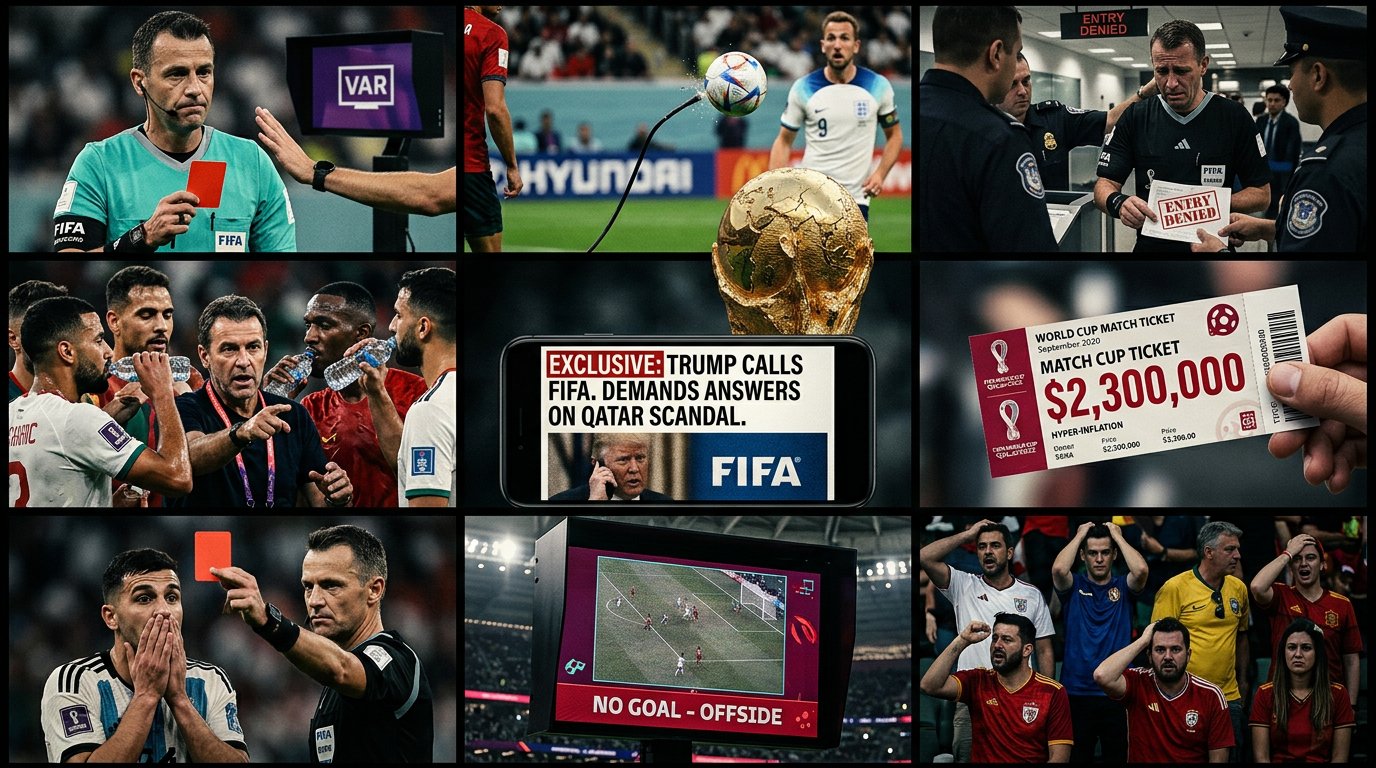
Let us be honest about something before we begin: every World Cup has controversy. It is baked into the tournament’s DNA. The hand of God. The phantom goal. The headbutt. The bite. The red card that wasn’t. The penalty that was. Disputed decisions are as much a part of World Cup folklore as the goals they overshadow.
But the 2026 FIFA World Cup is different. This is not a tournament with one or two controversial moments that will be debated by fans in pubs for decades. This is a tournament where the controversy has been so relentless, so varied, and so deeply woven into the fabric of the competition that the football itself has sometimes felt like a subplot.
From the Oval Office to the VAR booth, from $2.3 million ticket prices to a camera cable that may have changed the course of a quarterfinal, from a host nation actively at war with a participating country to a red card rule so bizarre it sounds made up — this World Cup has delivered scandal after scandal with a frequency that has left even veteran observers exhausted.
Here, in chronological order of escalation, are the eight controversies that have defined — and in some cases, overshadowed — the 2026 FIFA World Cup.
1. The Host Nation at War With a Participant
What happened: For the first time in the 96-year history of the World Cup, a host nation — the United States — entered the tournament actively engaged in military conflict with one of the participating countries. Iran had qualified for the tournament fairly, finishing second in their Asian qualifying group behind Japan. But by the time the first ball was kicked in June 2026, US-Iran relations had deteriorated to the point of open hostilities.
Iran’s football federation abandoned plans to establish a training base on American soil, relocating instead to Mexico. The Iranian delegation faced severe travel restrictions, with players and staff required to follow strict entry and exit protocols whenever they crossed into the United States for matches. Iranian coach Amir Ghalenoei, never one to mince words, called his team “the most oppressed team in the whole World Cup” — a statement that resonated far beyond the world of sport.
FIFA’s founding statutes explicitly require political neutrality. The organization’s refusal to relocate Iran’s matches away from the United States — despite repeated requests and clear security concerns — raised fundamental questions about whether the governing body prioritizes its relationship with powerful host nations over its duty of care to all participating teams equally.
2. The Somali Referee Who Never Got to Officiate
What happened: Omar Abdulkadir Artan was supposed to make history. The 34-year-old Somali referee had been selected to officiate at the 2026 World Cup, becoming the first official from Somalia ever chosen for football’s biggest stage. It was a triumph of perseverance — Artan had survived civil war, displacement, and the near-total collapse of Somalia’s sporting infrastructure to reach the pinnacle of his profession.
He never made it onto the pitch. The United States denied him entry on national security grounds. Despite diplomatic interventions from the Somali government, the African Football Confederation, and FIFA itself, the decision was not reversed. FIFA removed him from the tournament roster entirely.
The symbolism was devastating. A tournament that bills itself as a celebration of global unity had just told an African referee — a man who had overcome more obstacles than most of the players on the pitch will ever face — that he was not welcome.
3. The $2.3 Million Final Ticket
What happened: Somewhere in the labyrinth of FIFA’s official resale platform, a listing appeared for a single ticket to the World Cup final. The asking price: $2.3 million. That is not a typo. Two million, three hundred thousand dollars. For one seat. At a football match.
The listing was extreme, but the broader trend was real. Category 1 seats for the final were listed at over $11,000 face value. Train fares in New Jersey surged from approximately $13 to nearly $100 during tournament periods. Hotels implemented “World Cup pricing” that multiplied standard rates by factors of five, eight, even twelve.
The World Cup was supposed to be the people’s game. Now a family of four would need to spend roughly the annual median household income in several participating nations just to attend a single knockout-stage match. The pricing has sparked a broader conversation about who football actually belongs to.
4. The Mouth-Covering Red Card That Made History
What happened: In Paraguay’s group-stage match against Turkey, midfielder Miguel Almiron covered his mouth with his hand while speaking to an opponent. Under FIFA’s new mouth-covering regulation — introduced specifically for the 2026 tournament — this constitutes an offense. After a VAR review, referee Ivan Barton produced a straight red card. Almiron became the first player in World Cup history to be sent off for covering his mouth.
The rule was designed to prevent players from hiding abusive language from officials and broadcast cameras. But its application has been inconsistent. In England’s group-stage match against Ghana, Jude Bellingham was photographed covering his mouth while speaking to Jordan Ayew — but was not sanctioned because the exchange was deemed “non-confrontational.” How officials determine the content of a conversation they cannot hear, based on a gesture specifically designed to prevent them from hearing it, has become one of the tournament’s most surreal debates.
5. Trump Calls Infantino: The Balogun Red Card That Shook the World
What happened: US striker Folarin Balogun received a straight red card against Bosnia and Herzegovina in the group stage. The automatic one-match suspension was overturned. According to multiple reports later confirmed by President Trump himself, the US president made a direct phone call to FIFA president Gianni Infantino and asked for the decision to be reviewed.
Trump did not deny it. “Yes, I asked for a review by FIFA,” he told reporters. “All I did was ask for a review. I didn’t say that you have to do this.” FIFA’s disciplinary committee, citing a rarely-used “probationary” clause, suspended Balogun’s suspension.
The backlash was immediate and ferocious. UEFA accused FIFA of “crossing a red line” and making an “incomprehensible and unjustifiable” decision that undermined “the integrity of the game and the credibility of the competition.” Belgium filed a formal protest. Former FIFA president Sepp Blatter posted: “Red cards are not overturned by political phone calls.”
The irony was cruel. Balogun played against Belgium. The United States lost 4-1. Balogun registered the fewest touches of any player on the pitch. Belgium’s players celebrated by doing Trump’s signature dance move. The entire saga confirmed what critics had been saying for years: FIFA’s independence is a fiction.
6. VAR Run Amok: The Egypt Goal, the Croatia Offside, and the Technology Nobody Trusts
What happened: If the Balogun saga was the tournament’s political low point, the VAR catastrophe that unfolded across multiple matches was its technical nadir. The system that was supposed to eliminate controversy has instead become the single largest source of it.
In the Round of 16, Egypt’s Mostafa Ziko appeared to score a goal that would have put his team ahead against Argentina. VAR disallowed it — for a foul committed nearly 20 seconds earlier in the buildup. The referee had not whistled. Play had continued. Egypt had scored. And then VAR reached back across time to undo it. Egypt coach Hossam Hassan was blunt: “What’s happening isn’t fair.”
In Croatia’s quarterfinal against Portugal, an equalizer in stoppage time was disallowed because the match ball’s internal sensor detected a microscopic touch on striker Igor Matanovic that positioned Mario Pasalic fractionally offside. The touch was invisible to the naked eye. Croatia captain Luka Modric, possibly playing his final international match, stood on the pitch with an expression that needed no translation.
FIFA referees chief Pierluigi Collina defended every decision: “A foul is a foul. Regardless of whether the foul appears obvious, if the referee did not see it on the field of play, the VAR can intervene.”
VAR interventions at the 2026 World Cup have more than doubled compared to 2022. Red cards have tripled. The promise of VAR was certainty. What it has delivered is a different kind of uncertainty — one where goals are provisional, celebrations are tentative, and the true outcome of any play is unknown until a team of officials in a booth somewhere decides what happened.
7. The Bellingham Camera Cable Incident
What happened: England’s quarterfinal against Norway. First-half stoppage time. Jude Bellingham struck the equalizer that would ultimately send England to the semifinals. What nobody noticed in real time was that a camera cable from FIFA’s aerial broadcast system had dipped into the frame and made contact with the ball fractions of a second before the shot.
Under IFAB Law 5, Section 3, external objects entering the field require an immediate stoppage. The VAR team reviewed the incident — the review lasted just 17 seconds — and determined the contact was “incidental.” The goal stood. England won 2-1 in extra time. Norway filed a formal protest.
The “materially affect” standard that the VAR team applied does not exist in the Laws of the Game. The law is binary: outside agent enters field, play stops. No exceptions. Norway, a nation of 5.5 million people, was eliminated not by a superior opponent but by officials who decided enforcing the rules would be too controversial. The Norwegian newspaper VG ran a front page that said simply: “KABEL.”
8. The Hydration Breaks That Became Tactical Timeouts
What happened: Before the tournament, scientists warned that temperatures could exceed 40 degrees Celsius. FIFA introduced mandatory three-minute hydration breaks in each half. The intention was player safety.
The result was something entirely different. Coaches immediately weaponized the breaks as tactical timeouts — opportunities to reorganize, deliver instructions, disrupt the opponent’s momentum, and kill the flow of the game. Teams under pressure would suddenly get three minutes to reset. Teams with momentum would watch it evaporate while everyone stood around drinking.
The breaks also created additional advertising windows for FIFA’s sponsors. Spectators were simultaneously barred from bringing reusable water bottles into stadiums — allegedly to boost concession sales. The hydration breaks exemplify the central tension of the 2026 World Cup: FIFA’s stated intentions are increasingly at odds with its actions.
The Bigger Picture: What This World Cup Will Be Remembered For
In 20 years, when people look back on the 2026 FIFA World Cup, they will remember the goals. Bellingham’s brilliance. Vinicius Jr.’s magic. Mitoma’s artistry. Messi’s last dance. Ronaldo’s farewell. The moments of genuine sporting transcendence.
But they will also remember the controversies. The phone call from the White House. The camera cable. The $2.3 million ticket. The referee who never got to officiate. The team that had to train in a different country because the host nation was bombing theirs.
This was not just a World Cup. This was a stress test — of FIFA’s governance, of technology’s role in sport, of the idea that football can remain a game for everyone when the people running it seem determined to turn it into a product for the few.
The test results are not encouraging. But the beautiful game endures. It always does. It will be there in 2030, in the centenary World Cup. The question is whether FIFA will have learned anything by then.
History suggests the answer is no. But we will watch anyway. We always do.
Frequently Asked Questions
What is the biggest controversy of the 2026 World Cup?
While reasonable people can disagree, the consensus among media and fans points to two interconnected scandals as the most significant: President Trump’s phone call to FIFA president Gianni Infantino that preceded the overturning of Folarin Balogun’s red card suspension, and the broader VAR crisis that affected multiple knockout-stage matches. The Balogun incident was uniquely damaging because it involved direct political interference from a head of state. The VAR crisis was broader in scope, affecting more teams and raising fundamental questions about whether technology is improving football or destroying its essential character.
How did Trump get involved in World Cup officiating?
After US striker Folarin Balogun received a straight red card against Bosnia and Herzegovina — which came with an automatic one-match suspension — President Trump called FIFA president Gianni Infantino directly. Trump confirmed the call in an Oval Office press conference. FIFA’s disciplinary committee subsequently invoked a rarely-used “probationary” clause to suspend Balogun’s suspension, clearing him to play in the Round of 16 against Belgium. The decision was condemned by UEFA, the European Commission, multiple national football federations, and former FIFA president Sepp Blatter.
What is the mouth-covering rule and why is it controversial?
FIFA introduced a new regulation for the 2026 World Cup that penalizes players who cover their mouths with their hands while speaking to opponents during confrontations. Paraguay’s Miguel Almiron became the first player sent off under this rule against Turkey. The controversy stems from inconsistent application: England’s Jude Bellingham was photographed covering his mouth while speaking to Ghana’s Jordan Ayew but was not sanctioned because the exchange was deemed “non-confrontational.” Critics argue it is impossible to determine the content of a conversation that is deliberately being concealed.
What exactly happened with the camera cable and Bellingham’s goal?
During England’s quarterfinal against Norway, a camera cable from FIFA’s aerial broadcast system made contact with the match ball fractions of a second before Jude Bellingham struck his equalizing goal. Under IFAB Law 5, external objects entering the field require an immediate stoppage. VAR reviewed the incident in approximately 17 seconds and determined the contact was “incidental.” Norway filed a formal protest, arguing the “incidental” standard does not exist in the rules. Norway was eliminated and England advanced.
How expensive were World Cup 2026 tickets?
Category 1 seats for the final were listed at over $11,000 face value. The most extreme example was a single ticket on FIFA’s resale platform listed for $2.3 million. Train fares in New Jersey jumped from approximately $13 to nearly $100 during tournament periods. Hotel rates multiplied by 5-12 times standard pricing. The pricing has intensified debate about whether FIFA’s commercialization has made the tournament inaccessible to ordinary fans.
What happened with the Somali referee?
Omar Abdulkadir Artan, a 34-year-old Somali referee, was selected to become the first Somali official to referee at a World Cup. He was denied entry into the United States on national security grounds. Despite diplomatic interventions, FIFA removed him from the tournament roster. The incident became a symbol of the tension between the World Cup’s rhetoric of global inclusion and the practical barriers created by host nation immigration policies.
Will FIFA change any rules after this tournament?
FIFA has not announced formal rule changes, but the volume and intensity of controversy has made reform almost inevitable. Several national federations are expected to submit proposals including clearer VAR intervention definitions, stricter separation between political authorities and football governance, standardized hydration break protocols, and a review of the mouth-covering rule’s enforcement criteria. The Balogun incident has prompted calls for an explicit prohibition on political figures contacting FIFA officials regarding active disciplinary matters.
Disclaimer
This article is based on publicly available news reports, official FIFA statements and broadcasts, post-match press conferences, government statements, and verified social media content as of July 12, 2026. All incidents described are documented through multiple independent sources. The analysis and commentary represent the author’s synthesis of these events. This article is not affiliated with FIFA, any national football federation, or any participating team.
Published: July 12, 2026 | Last Updated: July 12, 2026
Sources: FIFA official communications, IFAB Laws of the Game 2025-26, The Guardian, BBC Sport, Politico, CNN, The Economic Times, News18, GQ, Rediff Sports, Yahoo Sports, The Daily Star, European Commission statements, Norwegian Football Federation, UEFA official communications.